
Ganda Mool Nakshatra Brings Serious Child Risks and Proper Shanti Vidhi Timing Delivers Safety
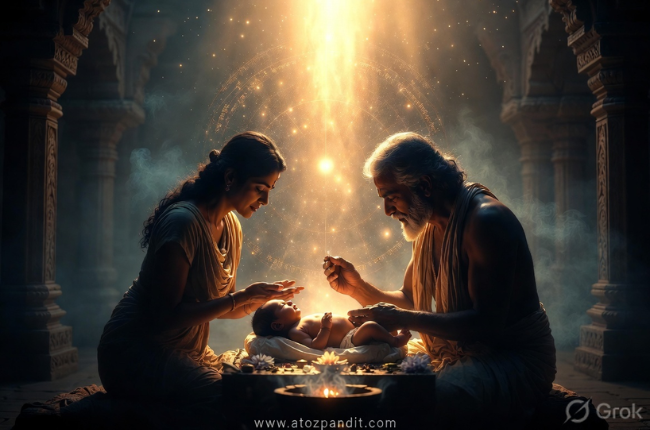
The moment a family's astrologer mentions "Ganda Mool" after a child's birth, the entire room changes. Grandmothers go quiet. Fathers start calling relatives. And young parents, often holding their newborn for the first time, are suddenly carrying a weight they don't fully understand.
We have sat with hundreds of such families over the years. The anxiety is real. But so is the misunderstanding.
Here is what we want you to know first, before anything else: Ganda Mool Nakshatra is not a curse. It is a karmic marker — one that classical Vedic tradition has described in detail and provided clear remedies for. The six Nakshatras involved — Ashwini, Ashlesha, Magha, Jyeshtha, Moola, and Revati — sit at sensitive astrological junctions. When a child is born with the Moon in any of these, specific attention and the right timing for the Shanti Vidhi can make a profound difference.
What most families are never told, however, is the full picture — which padas matter most, what the ritual actually does, and what happens if the 27-day window is missed. That is exactly what we will walk you through here.
What Exactly Is Ganda Mool Nakshatra — and Why These Six Stars?
The six Ganda Mool Nakshatras sit at the three zodiac junction points where water signs end and fire signs begin — Pisces to Aries, Cancer to Leo, and Scorpio to Sagittarius. As described in classical Vedic tradition, these Sandhi (junction) zones are spiritually volatile. The Moon's energy here is neither settled in its old home nor fully established in the new one.
The word "Ganda" means a knot, and "Mool" means the root. Together, our granthas describe this as "a karmic knot at the root of consciousness." When a child takes birth with the Moon placed in this region, the birth carries intensity — not just difficulty. The six Nakshatras are: Ashwini and Revati at the Pisces-Aries junction, Ashlesha and Magha at the Cancer-Leo junction, and Jyeshtha and Moola at the Scorpio-Sagittarius junction.
Each is ruled either by Ketu or Mercury — two grahas that govern transitions, dissolution, and sharp crossings. That is the essence of why these births demand attention.
Did You Know? As described in classical Vedic texts including the Jataka Parijata and Brihat Parashara Hora Shastra, the Gandanta period refers specifically to the last 48 minutes of the water sign Nakshatra and the first 48 minutes of the fire sign Nakshatra. A birth within this narrower 96-minute window is considered more intense than birth elsewhere in the same six Nakshatras. Not all Ganda Mool births sit in this deepest zone — always ask the astrologer to check the exact degree and time.
The Pada Truth Most Astrologers Forget to Tell Parents
This is the section most articles skip entirely — and it causes tremendous unnecessary fear.
Each Nakshatra spans 13 degrees and 20 minutes of the zodiac, divided into four equal parts called padas. Within the same Ganda Mool Nakshatra, different padas carry very different implications. As our Vedic granthas have long held, it is the specific pada of the Moon's placement — not merely the Nakshatra name — that determines the nature of any potential impact.
Take Moola Nakshatra as an example. Classical tradition describes the 1st pada as carrying the sharpest implications, particularly for the father's health or circumstances. The 2nd pada is traditionally associated with the mother's wellbeing. The 3rd pada involves wealth matters. But the 4th pada of Moola? It is considered relatively benign, and several classical texts mention that a child born here, with proper Shanti, may actually display leadership and depth of character.
Similarly, within Revati Nakshatra, the 4th pada is considered the most sensitive — it falls deep in the Gandanta zone. Ashwini's 1st pada carries more weight than the others. Families who have heard "your child is born in Ganda Mool" without hearing which pada are operating on incomplete information.
This is why we always say: get the full picture before deciding the urgency of the remedy.
Pandit's Tip: Before calling for the puja, request the astrologer to share the child's exact birth Nakshatra and pada number. Write it down. When a verified Pandit performs the Shanti Vidhi, the Sankalpa (sacred intention statement) will need this precise information for the ritual to be correctly oriented. A puja performed without the right Sankalpa is like writing a letter without the address. Everything depends on personal faith, sincere effort, and divine grace — and it begins with having the right information in hand.
The Gandanta Zone: A Spiritual Knot, Not Just a Danger Signal
Here is what competitors almost never explain, and what changes everything for parents who understand it.
The Gandanta is not merely a bad zone in the zodiac. As described in classical Vedic tradition, it is a point where the soul is in transition between two fundamental states of consciousness. Water signs represent the dissolving of old patterns. Fire signs represent the beginning of a new impulse. A soul born at this junction is, in a very real sense, being born mid-transition.
This creates what our granthas describe as an inner knot — a deep karmic tension that the native will need to work through. In practical life, this can show up as early childhood health sensitivities, a certain intensity in personality, or what families notice as an unusual seriousness even in young children born in these Nakshatras.
But here is what the fear-based framing misses: the Gandanta is also described as a zone of deep spiritual possibility. Some of India's most revered spiritual figures and intellectually formidable personalities have birth Moons in these very Nakshatras. The intensity cuts both ways.
The remedy — the Shanti Vidhi — is not about "removing" the Nakshatra. It is about harmonising the child's karmic entry point with the surrounding family energy. Think of it as welcoming a child whose arrival created a stir at the cosmic level. You are setting the tone.
The 27th Day Rule: Why Timing Is Everything in the Shanti Vidhi
The most important practical question for any family is this: when must the ritual be done?
As described in classical Vedic tradition, the ideal time for the Ganda Mool Shanti Puja — also known as the Sataisa Puja — is the 27th day after the child's birth. The name "Sataisa" itself comes from "Satais," meaning twenty-seven. The reasoning is precise: the Moon takes approximately 27.3 days to complete one orbit of the zodiac. On the 27th day, it returns to the same Nakshatra it occupied at birth. This is the natural reset point — the moment when the cosmic imprint of the birth can be most effectively addressed.
The puja is performed in the Muhurta when the Moon is again in the child's birth Nakshatra. This requires correct Panchang calculation specific to your city and time zone — a standard calendar alone is not sufficient.
What if the 27th day has already passed? This is one of the most common anxious questions we receive. The answer, as our classical tradition holds, is reassuring: the ritual may be performed at any subsequent recurrence of the birth Nakshatra — ideally within 27 months, and traditionally within 27 years. The 27th day is the most potent window, but it is not the only one. Many families in diaspora communities, or those who did not know about the requirement initially, have performed this ritual months or even years later with complete sincerity and Vidhi accuracy.
Key timing table:
Window | Potency | Notes |
27th day after birth | Highest | Moon in exact birth Nakshatra |
Next Nakshatra recurrence (monthly) | Very Good | Available almost every month |
Within 27 months | Good | Strongly recommended if 27th day missed |
Within 27 years | Valid | Classical upper limit mentioned in tradition |
Quick Remedy Box: If you have just discovered the Ganda Mool placement and are not near the 27th day, note the child's birth Nakshatra and check the next date when that Nakshatra repeats in the Panchang for your city. That day becomes your next valid Muhurta window. Keep clean new clothes for the child and both parents ready. The Pandit will need the child's exact birth date, time, place, and the Nakshatra-Pada information for the Sankalpa. As with any Vedic practice, the sincerity of preparation mirrors the sincerity of the ritual itself.
What the Sataisa Puja Actually Involves — Step by Step
Many families have heard of the ritual but never actually been told what happens inside it. Let us walk through what our traditional Vidhi involves.
The puja opens with Gauri-Ganesha Puja — removing any obstacles from the ritual space itself. The Pandit then performs a Sankalpa: a formal sacred declaration that names the child, the birth details, the Nakshatra-Pada, and the specific intention of the ritual. This Sankalpa is the soul of the puja. Without it, the ritual lacks direction.
What follows is the worship of all 27 Nakshatras, with special emphasis on the child's specific Ganda Mool Nakshatra and its presiding deity. The ritual then proceeds to a particularly beautiful step: Abhishekam. Water drawn from 27 different sources — traditionally wells, but adapted in modern practice to include Gangajal and water from other sacred sources — is combined with 27 types of leaves. This mixture is used to perform a sacred bathing of the child and the parents. The sensory experience of this moment — the fragrance of multiple leaves, the cool water, the vibration of mantras filling the room — is deeply settling for the entire family.
A small Havan follows, with specific offerings to the Nakshatra lord and the presiding deity. For Ashwini, Magha, and Moola (Ketu-ruled Nakshatras), blessings are directed to Lord Ganesha. For Ashlesha, Jyeshtha, and Revati (Mercury-ruled Nakshatras), as classical tradition holds, Lord Brihaspati and Lord Vishnu are invoked. The ritual closes with Brahmin Bhojan or grain donation — an act of Daan that completes the karmic circuit the ritual has opened.
The AtoZPandit Framework: North Indian vs. South Indian Variations in Ganda Mool Shanti
This is a dimension that most online resources completely overlook — and families who follow South Indian traditions have told us they feel invisible in most Ganda Mool content.
In North Indian tradition, the Ganda Mool Shanti is primarily Moon-Nakshatra focused. The ritual emphasises the child's Janma Nakshatra, the Nakshatra's ruling deity, and the Navagraha puja as support. The Abhishekam with 27 leaves is standard, and the Havan is conducted with Nakshatragana mantras.
South Indian families — particularly those following Tamil, Telugu, and Kannada Panchang traditions — place greater emphasis on the Rashi lord alongside the Nakshatra lord. In many South Indian households, the Graha Shanti for the Moon (Chandra Shanti) is performed as a companion ritual to the Nakshatra Shanti, since the Moon's strength or weakness in the overall chart heavily shapes how the Ganda Mool condition expresses itself.
Kerala families following a different Panchang system may calculate the 27th day slightly differently due to variation in Nakshatra start times. If your family follows a specific regional tradition, always work with a Pandit familiar with your Panchang lineage — not just a generalist.
The AtoZPandit team has worked with families across these traditions and can match the appropriate regional Vidhi to your family's background. This matters more than most families realise. The ritual finds its deepest resonance when performed within the practitioner's own living tradition.
Regional Wisdom Note: In the Marwari and Gujarati communities of North India, the Ganda Mool Shanti is sometimes combined with a Naamkaran (naming ceremony) on the 27th day — two sacred events held together. This is a beautiful and efficient practice. In contrast, many South Indian families keep the two ceremonies separate, feeling that the Shanti should be completed before the naming. Both approaches are valid within their own traditions. Discuss the sequence with your family elders and your Pandit before scheduling.
What Happens After the Shanti — The Signs That It Has Taken Effect
Parents always ask us this: how will we know it worked?
Vedic tradition does not offer quantifiable proof — and any practice or resource that promises you measurable results has stepped outside the boundaries of authentic guidance. What our granthas teach us is that the Shanti ritual creates alignment. It harmonises the child's karmic starting point with the family's energy field. What unfolds after that is in the hands of the child's own karma, the family's continued practice, and divine grace.
That said, experienced Pandits and grandmothers who have witnessed many such rituals will often describe the atmosphere of the home changing in the weeks following the puja. A sense of settled calm. Parents feeling less inexplicably anxious. The child feeding better, sleeping with more ease. These are not claims we make — they are what families across generations have described, as our rishis observed across their years of guidance.
What we do say with confidence: the ritual creates a conscious moment of acknowledgement. You are telling the cosmos, in the most precise language Vedic tradition has developed, that you recognise the sensitivity of this birth and you are responding with attention, devotion, and the correct Vidhi. That intention — held sincerely and acted upon with the right guidance — is never wasted.
After the Shanti, continue the Nakshatra-specific daily practices: for Ketu-ruled Ganda Mool children, worship of Lord Ganesha on Wednesdays and chanting of the Ganesha mantra. For Mercury-ruled Nakshatras, regular offering of flowers and prayers to Lord Vishnu can be woven gently into the family's daily routine.
Closing Thought + Remedy: The greatest mistake families make after a Ganda Mool birth is not the missed 27th day — it is the sustained fear that follows them for years without resolution. The ritual exists precisely to transform that fear into conscious action. Once the Shanti Vidhi is performed with sincerity, the family can let go. As our Puranas teach us, a burden carried to the altar with full devotion does not need to be carried home again. The remedy opens the door — walking through it with faith is what creates the shift.
Frequently Asked Questions
Can Ganda Mool Nakshatra children grow up to be successful? Absolutely — and this is something classical texts acknowledge directly. As our Vedic granthas have long held, some of the most spiritually gifted and intellectually deep individuals carry Ganda Mool birth placements. The intensity of the Gandanta zone cuts both ways. What the tradition asks of families is not fear, but the right ritual response at the right time.
What if the father is travelling or unwell — can the mother do the puja alone? In most North Indian traditions, both parents ideally participate in the Abhishekam together. However, as described in classical Vedic tradition, if one parent is absent, the ritual may still proceed with the present parent holding the Sankalpa for the family unit. Consult your Pandit to frame the Sankalpa appropriately.
Is the Ganda Mool Shanti Puja a one-time ritual? As described in classical Vedic tradition, this puja is performed once in the child's life. There is no need to repeat it annually or at every Nakshatra recurrence. Once performed correctly with full Vidhi, the ritual is considered complete.
What if my child is now an adult and the puja was never done? The ritual remains valid. Several classical texts mention 27 years as the outer window. An adult can perform the Shanti on their own behalf, or parents can do so on behalf of their child at any recurrence of the birth Nakshatra. Sincerity and correct Vidhi matter more than the time elapsed. Everything depends on personal faith and the depth of one's surrender to the divine.
Should I avoid telling the child about the Ganda Mool placement? This depends on the child's age and temperament. What we consistently advise: if and when you do speak about it, frame it as our granthas do — a marker of karmic intensity, not a mark of bad fortune. The ritual is not hiding something shameful; it is completing something important.
Conclusion
Ganda Mool Nakshatra is one of those Vedic concepts that can either terrify a family or deepen their faith — depending entirely on how it is explained and handled. The six Nakshatras involved sit at real, meaningful astrological junctions. The 27th-day Shanti Vidhi exists for a reason that our classical tradition has preserved with care. And the pada-by-pada nuance means that no two Ganda Mool births are identical.
If your child has been born in one of these Nakshatras, you are not facing bad luck. You are facing a specific karmic condition for which a specific, beautiful, and time-tested remedy exists. Act with the right timing, find a Pandit who knows the correct Vidhi for your regional tradition, and hold the ritual with sincerity.
Please note: All information shared in this article is for general educational purposes and cultural awareness of Vedic traditions only. AtoZPandit.com does not claim, guarantee, or take responsibility for any specific outcomes based on this content. Nothing here should be taken as a substitute for qualified medical advice, professional guidance, or any regulated service. If your child has health concerns, please consult a qualified medical professional without delay. All Vedic remedies described are rooted in traditional heritage and shared in that spirit alone.
If your child's birth chart shows a Ganda Mool placement and you would like guidance on the correct Nakshatra-Pada, the right Muhurta window for your city, and which regional Vidhi applies to your family tradition, the team at AtoZPandit.com is here to help you find the right verified Pandit — without panic, and with complete clarity.
A gentle reminder: our guidance is for educational and spiritual orientation only and is not a substitute for medical advice, legal counsel, or any professional service. Every family's circumstances are unique, and outcomes rest entirely on personal faith, sincere effort, and divine grace. Jai Shree Krishna 🙏