
Pitra Dosha: The Hidden Ancestral Cause Behind Repeated Failures and Exact Tarpana Rituals That Clear the Debt
There is a conversation that happens in many Indian households — usually at the kitchen table, over chai, in a low voice — when things have been going wrong for too long. A young man who cannot find a suitable bride despite everything being in order. A daughter who has had repeated miscarriages with no medical explanation. A business that starts well and collapses, again. A family where health problems cluster in the same generation. Someone finally says: "Has anyone done the Shraddha properly in recent years? What about our grandfather — was his last rite done right?"
That whispered question is often the first honest acknowledgement of Pitra Dosha.
Pitra Dosha — also written as Pitru Dosha — is not a supernatural punishment. It is a karmic imbalance recorded in the birth chart, arising from ancestral souls who did not receive proper ritual care at the time of their passing, or who carry unresolved desires and debts from their earthly lives. As the Garuda Purana, Matsya Purana, and Manu Smriti all teach us, the relationship between the living and the departed does not end at cremation. The obligation continues — through Tarpana, through Shraddha, through honest remembrance.
This guide gives you everything you need: how to recognise this dosha by its symptoms, how to confirm it in a kundli, and which level of ritual — from simple home practice to formal Narayan Bali puja — is actually appropriate for your family's situation.
How Pitra Dosha Forms in a Kundli — The Planets and Houses That Tell the Story
Pitra Dosha is one of the most reliably identifiable conditions in a birth chart, once you know what to look for. It does not announce itself with a single planet in a single house. It shows as a pattern — of afflictions across the houses and planets that govern ancestry, lineage, and paternal energy.
The 9th house is the primary house of Pitra Dosha. This house governs our forefathers, dharma, and the blessings we receive from those who came before us. When malefic planets — particularly Rahu, Ketu, Saturn, or an afflicted Sun — occupy or aspect the 9th house without benefic relief, classical Jyotish texts identify this as a clear indicator of ancestral karmic debt. Rahu conjunct the Sun in the 9th house is considered the most direct and intense formation.
The 5th house is the second key indicator. As the 9th house represents the karma we inherited, the 5th house shows how that karma affects our own children — progeny, education, creative expression. A debilitated or malefic-afflicted 5th house lord, or Ketu's presence in the 5th, is strongly associated with the progeny difficulties that so often bring families to seek ancestral healing.
Beyond these, additional planetary combinations that classical texts describe as Pitra Dosha indicators include: Sun with Saturn (a combination that brings tension between the soul's aspiration and its karmic burden); Rahu in the 9th house alone (even without Sun, representing disconnection from ancestral guidance); and Saturn retrograde in the 1st, 9th, or 10th house, which carries a quality of unfinished ancestral business being replayed through the current generation.
One point almost no competitor article addresses: the distinction between paternal and maternal lineage dosha. In classical Jyotish, Sun represents the paternal line — the father, grandfather, and ancestors up to seven generations back. Moon represents the maternal line — the mother, maternal grandparents, and ancestors up to four generations. If the Moon is afflicted by Ketu or Saturn in the chart rather than the Sun, the ancestral imbalance may come from the mother's side. The remedy, then, must include maternal ancestors in the Tarpana invocation — which most generic instructions do not specify.
📦 Quick Remedy Box — Monthly Amavasya Practice
When to use: Every Amavasya (new moon day), year-round — even if Pitru Paksha is months away. Core Dravya: Black sesame seeds (kala til), barley (jau), Gangajal or clean river water, a copper or brass vessel, kusha grass Practice: At sunrise, face south (the direction of the Pitru Loka). Add black sesame seeds and barley to water in a copper vessel. With both hands, pour the water slowly toward the earth while speaking the names of your departed parents and grandparents, then add: "Om Sarva Pitru Devataabhyo Namah." Follow with a simple Daan — offer food, sesame, or a small cash gift to someone in need. As described in the Garuda Purana, this monthly Tarpana act satisfies the ancestral soul's fundamental need for remembrance and nourishment across the subtle realms. As our rishis observed across generations — it is not the grandeur of the ritual but the sincerity of remembrance that reaches the Pitru Loka. Everything depends on personal faith, sincere effort, and divine grace.
The Three Types of Pitra Dosha — Why One Remedy Does Not Fit All
This is the section that most articles on Pitra Dosha simply do not include — and it is the reason why well-intentioned families perform Shraddha year after year without seeing the shift they hoped for.
Classical Vedic tradition, as described across the Garuda Purana and allied texts, recognises three distinct roots of ancestral karmic debt. Understanding which type is present shapes the entire remedial path.
Type 1 — Pitru Rin (Ancestral Debt from Neglect): This is the most common form. It arises when the living members of a family have, across generations, failed to perform the prescribed Shraddha, Tarpana, and Pind Daan on the appropriate tithis. The ancestors are not restless due to any grave sin — they simply have not received the nourishment and formal release that the ritual tradition provides. The remedy here is consistent annual Pitru Paksha Shraddha, monthly Amavasya Tarpana, and regular acts of Anna Daan (food offering) to Brahmins or the needy. This is fully manageable through home practice with proper guidance.
Type 2 — Pitru Shaap (Ancestral Curse from Wrongdoing): This is more serious. It arises when an ancestor during their lifetime caused significant harm — to another person, to the environment (particularly harming serpents or uprooting sacred trees), or to family members. The departed soul carries the weight of this unresolved action, and the dissatisfaction reverberates into the birth charts of descendants. The planetary signatures are typically more acute — Rahu strongly placed in the 9th house, or Sun deeply afflicted. The remedy requires not just annual Shraddha but formal Narayan Bali puja at Trimbakeshwar, as described in the 40th chapter of the Garuda Purana — a three-day ritual specifically designed to invoke and formally release souls carrying unresolved karmic weight.
Type 3 — Pitru Dosha from Unnatural Death (Akal Mrityu): When a family ancestor died by accident, suicide, drowning, or any sudden unnatural cause, the Antyeshti (last rites) are often performed in a state of shock and grief — and may be incomplete. The soul, not having received the full thirteen-day rite, remains in an intermediate state unable to move toward its next journey. In such cases, Narayan Bali is not merely recommended — it is the specific ritual designed precisely for this situation. As the Garuda Purana prescribes, Narayan Bali recreates the funeral process through an effigy of wheat flour, complete with all the rites of cremation, freeing the soul to complete its transition.
Knowing which type affects your family is not possible from a symptom list alone. It requires a careful reading of the chart combined with honest family history. This is why a consultation with a knowledgeable Jyotishi — not a generic calculator — is the necessary starting point for families experiencing severe or multi-generational symptoms.
What Pitra Dosha Feels Like — Reading the Symptoms Across Generations
The defining quality of Pitra Dosha is generational repetition. When the same type of misfortune appears across multiple family members in different generations — not just one person having a bad year — that is when ancestral karma becomes the serious consideration.
Symptoms in the family pattern: Marriage that consistently delays across siblings or cousins in the same generation. Repeated miscarriages or difficulty conceiving children — particularly when medical investigation yields no clear answer. Multiple members of the same family suffering from chronic illness that is difficult to diagnose or that does not respond typically to treatment. Financial growth that reaches a certain point and then consistently stalls or reverses.
Symptoms in the home atmosphere: Persistent tension and conflict between family members who love each other — disagreements that escalate disproportionately, particularly during specific lunar periods. A sense of ancestral heaviness that descends during certain months of the year, often corresponding to the tithi of a departed family member.
Symptoms in dreams: This is described across multiple Puranic references as one of the clearest signals. Recurring dreams of deceased parents or grandparents who appear with expressions of sadness, unease, or urgency. Dreams of water, floods, or being lost. The most specific signal — seeing the same departed person repeatedly across multiple family members' dreams during Pitru Paksha.
The critical diagnostic question: Is this pattern repeating in your family across generations — or is it one person's difficult phase? If multiple cousins are simultaneously facing marriage delay, or if two generations of women in the family have faced miscarriage, or if the men of the family consistently face a particular career ceiling — these are ancestral, not individual, patterns.
💡 Pandit's Aside — The Question Nobody Asks the Elders
The most valuable research for Pitra Dosha is not astrological — it is genealogical. In our experience sitting with family after family, the turning point always comes when someone finally sits down with the eldest living member of the family — a grandmother, a great-uncle, whoever carries the memory — and asks: "Was there someone in our family who died suddenly, or whose last rites we are not sure were complete? Is there a relative whose Shraddha nobody has been doing?" Almost always, a name emerges. A grandfather who died in an accident and whose family scattered before the thirteen-day rite concluded. A great-grandmother whose Shraddha stopped after the person who performed it also passed. An uncle who died abroad and about whom nobody knows what rituals, if any, were done. This is not about blame. It is about completing what was left incomplete. The simplest way to begin is to include that person's name specifically in the next Amavasya Tarpana — and to commit to the annual Shraddha for every departed family member you can name. Our granthas tell us: it is never too late to remember. The ancestors are waiting for exactly this — to be called by name, with love.
The Exact Tarpana Ritual — Step by Step for Home Practice
Tarpana, from the Sanskrit root Trup meaning "to satisfy," is the water-offering ritual that forms the foundation of all ancestral healing practice. It can be performed at home, at a sacred river, or at a temple tank. Here is the complete procedure as described in classical tradition:
Preparation: Perform the ritual at sunrise or in the morning hours, on the tithi (lunar day) corresponding to your ancestor's death date, or on any Amavasya if the exact date is unknown. Take a purifying bath before beginning. Wear clean, simple, white or light-coloured clothes. Gather: a copper or brass vessel filled with clean water, black sesame seeds (kala til), barley grain (jau), Gangajal if available, kusha grass, and a clean cloth or grass mat to sit on.
Direction and posture: Sit facing south — the direction of Yama, the lord of the ancestors' realm. Place the kusha grass beneath you and hold the copper vessel in both hands.
Sankalpa (Sacred Intention): Before pouring, state your intention clearly. A traditional Sankalpa includes your own name, your gotra (ancestral lineage), and the names of those for whom you are performing the Tarpana. If you do not know the gotra, use the phrase "mama pitru-paryantanam sarvesham" — "to all in my ancestral line." This invocation, as described in the Manu Smriti, is sufficient to reach the souls even when individual names are unknown.
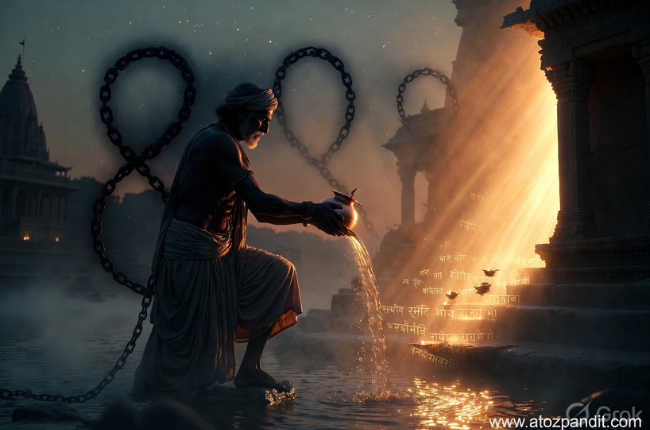
The Offering: Add black sesame seeds to the water. Mix gently. Pour the water slowly from the vessel into the ground or a plant, letting it trickle in a steady stream. As you pour, chant: "Om Pitribhyo Namah. Swadhaayai Namah." Tarpana is traditionally offered three times — once for the immediate forefathers (parents, grandparents), once for the forefathers of forefathers, and once for the full ancestral lineage extending into the unknown generations.
Pinda (Rice Ball Offering): For a complete Shraddha rather than Tarpana alone, prepare small balls of cooked rice mixed with black sesame seeds, ghee, and barley. Place these on a banana leaf or sacred grass facing south. These are the Pindas — symbolic nourishment for the physical body of the departed. Offer them with the invocation of each ancestor's name. As described in classical texts, Pitrus are believed to receive these as crows, so placing the Pindas where crows can access them is the traditional completion of this act.
Daan (Charitable Giving): Every Tarpana and Shraddha ritual is sealed with Daan — charitable giving performed specifically in the name of the ancestors. Offering food to Brahmins, to the needy, to cows, or to birds on the day of the ritual completes the act. As our Vedic texts teach us, the merit (punya) generated by Daan travels directly to the ancestral soul, contributing to their peace and eventual liberation.
The Ritual Ladder — From Amavasya Practice to Narayan Bali
Not every Pitra Dosha requires the same level of intervention. One of the most important services a knowledgeable Jyotishi can provide is telling you which rung of the ladder your family's situation actually calls for — and saving you from either under-doing or over-investing.
Rung 1 — Monthly Amavasya Tarpana (Always, For Everyone): This is the foundational practice that every Hindu family should maintain regardless of whether Pitra Dosha has been identified. Monthly water offerings, black sesame, and a simple act of Daan on every new moon day — performed with sincere remembrance of the departed. This is described as the minimum rightful duty (Pitru Rin) in the Manu Smriti.
Rung 2 — Annual Pitru Paksha Shraddha (For Type 1 Pitra Dosha): The sixteen days of Pitru Paksha — the dark fortnight of Bhadrapada month, typically falling in September-October — are the most charged period for ancestral ritual work. As classical texts describe, during this fortnight, the gates between the living world and the Pitru Loka open most fully, and offerings reach ancestral souls with particular potency. A complete Shraddha during Pitru Paksha — with Tarpana, Pinda Daan, feeding of Brahmins, and charitable giving — is the annual obligation for Type 1 Pitra Dosha. If the ancestor's death tithi is unknown, Sarva Pitru Amavasya (the last day of Pitru Paksha, also called Mahalaya Amavasya) is the universal day — on which, as described in classical texts, a Shraddha performed carries the efficacy of one performed at Gaya.
Rung 3 — Tripindi Shraddha (For Skipped Generations): When Shraddha has not been performed for three or more consecutive generations for the same ancestor, a specific ritual called Tripindi Shraddha is prescribed. This is most authentically performed at Trimbakeshwar or Gaya, under the guidance of experienced pandits who know the specific Vedic procedure. Tripindi Shraddha covers the obligation for three generations simultaneously, formally acknowledging and closing the accumulated gap of neglected rites.
Rung 4 — Narayan Bali at Trimbakeshwar (For Type 3 — Unnatural Death): As described in the 40th chapter of the Garuda Purana, Narayan Bali is the specific remedy when a family ancestor died by an unnatural cause — accident, sudden death, drowning, or death far from home with incomplete rites. This three-day ritual at Trimbakeshwar recreates the full funeral process for the departed soul using an effigy of wheat flour, invokes the soul through Vedic mantras, completes the symbolic cremation, and formally releases the soul toward its next journey. This is not a general "Pitra Dosha puja" — it is a specific intervention for a specific category of ancestral unrest, and should be reserved for situations where the family history confirms an unnatural or incomplete departure.
Rung 5 — Pind Daan at Gaya (For Full Ancestral Liberation): Gaya in Bihar — where the Vishnupad temple stands on the banks of the Falgu river — is considered in our tradition the supreme site for Pind Daan. It is described across the Ramayana, Mahabharata, and Puranas as the tirtha where Lord Rama himself performed Shraddha for King Dasharatha. A Pind Daan performed at Gaya is said to bestow Moksha on the ancestor across seven generations of the paternal line and four of the maternal line. For families carrying deep, multi-generational Pitra Dosha — particularly where the chart shows severe afflictions across both the 5th and 9th houses — a Gaya pilgrimage for full Pind Daan is the most complete ancestral healing act our tradition offers.
🌍 Regional Wisdom Note
North India: In the Gangetic belt — UP, Bihar, Rajasthan, Madhya Pradesh — the primary practice is Shraddha and Pind Daan at Gaya, Haridwar, Prayagraj (Allahabad), or Kashi (Varanasi). The Pitru Paksha fortnight is observed with great seriousness, and families traditionally avoid weddings, new ventures, and celebrations throughout these sixteen days. North Indian families also observe a specific practice of offering food to crows on each day of Pitru Paksha — crows being considered the vehicles through which Pitrus receive the offering. In many Rajasthani and UP households, a family member will fast on the death tithi of a parent every year for life as a form of personal Shraddha.
South India: In Karnataka, Andhra Pradesh, Tamil Nadu, and Kerala, the ancestral ritual period is often called Mahalaya Paksha or Mahalaya Amavasya, with particular emphasis on the final day. In Tamil tradition, the monthly equivalent of Amavasya Tarpana is observed on each Amavasai with great consistency, and is considered a family obligation even for younger generations. In Karnataka, Gokarna — a sacred temple town on the western coast — is one of the most important sites for Pitru Shraddha and Narayan Bali puja, with scriptural sanction dating back fifteen centuries. South Indian families also observe Ashlesha Bali at Gokarna — a puja on the Ashlesha Nakshatra of each month specifically for ancestral healing, particularly where serpent karma is involved alongside Pitra Dosha.
Both traditions ultimately share the same essence: the ancestors who blessed this life deserve remembrance. The ritual language differs by region — but the love it carries crosses every boundary.
Frequently Asked Questions
Can Pitra Dosha be passed from mother's side as well as father's? Yes — and this is one of the most consistently missed dimensions of Pitra Dosha. As classical Jyotish describes, the Sun represents paternal lineage and the Moon represents maternal lineage. When the Moon carries Ketu or Saturn afflictions rather than the Sun, the dosha roots may lie in the maternal ancestral line. In such charts, Tarpana invocations must specifically include maternal grandparents and their lineage. A proper chart reading reveals which line requires primary attention.
We have never done Shraddha in our family for decades. Is it too late? It is never too late. Our Puranas specifically describe that even an ancestor who has been without Shraddha for generations will receive the offering when it is finally made with sincere intent. The appropriate starting point is Sarva Pitru Amavasya — the final day of Pitru Paksha — which covers all ancestors regardless of whether their individual tithi is known. Beginning practice this year, consistently, is always the right answer.
Can women perform Tarpana? Classical texts indicate that the eldest male heir is the traditional performer of Shraddha and Tarpana. However, when no male heir is present, daughters, widows, and female family members may perform the ritual — and their sincerity is fully accepted, as described in classical Vedic tradition. In many South Indian families, women have maintained the Amavasya Tarpana practice independently for generations.
What is the difference between Tarpana, Shraddha, and Pind Daan? As our granthas clarify: Tarpana is the water offering alone — the simplest act of ancestral nourishment. Shraddha is the complete rite: Sankalpa, Tarpana, Pinda preparation and offering, feeding of Brahmins, and Daan. Pind Daan is specifically the rice-ball offering, which forms the central act of a full Shraddha. Each is valid; each has its place in the ritual ladder. Everything depends on the sincerity with which one turns toward the practice.
Which is more powerful — home Tarpana or a professional puja at Trimbakeshwar or Gaya? Both carry genuine power. Home Tarpana performed consistently, with sincere intent and proper Sankalpa, carries the weight of personal devotion — and as described in classical texts, the annual Sarva Pitru Amavasya Shraddha performed at home carries the efficacy of one at Gaya. A formal puja at a sacred site adds the energy of the tirtha itself — particularly significant for Type 2 and Type 3 doshas. As our granthas remind us, the remedy opens the door; walking through it sincerely is what matters.
Conclusion
Pitra Dosha is, at its heart, an invitation from your ancestors to be remembered. Not feared. Not placated with expensive ritual alone. Remembered — by name, with water, with food offered to the hungry, with a lamp lit on the Amavasya night. Our Vedic tradition gives us a complete, graduated, practical system for this: from the monthly Tarpana anyone can perform at home, to the Pitru Paksha Shraddha that honours the full ancestral lineage, to the specific formal pujas for the rare cases where ancestral souls need deeper assistance.
The patterns in your family do not have to repeat another generation. Our granthas show us the path. Jai Shree Krishna. 🙏
Are the symptoms of Pitra Dosha present in your family — and you are unsure which type is active, which ancestors to invoke, or which rung of the ritual ladder is appropriate? Connect with AtoZPandit for a complete Pitra Dosha chart analysis and personalised remedial guidance.Book your consultation at atozpandit.com/pitra-dosha-hidden-cause